
PROBLEM
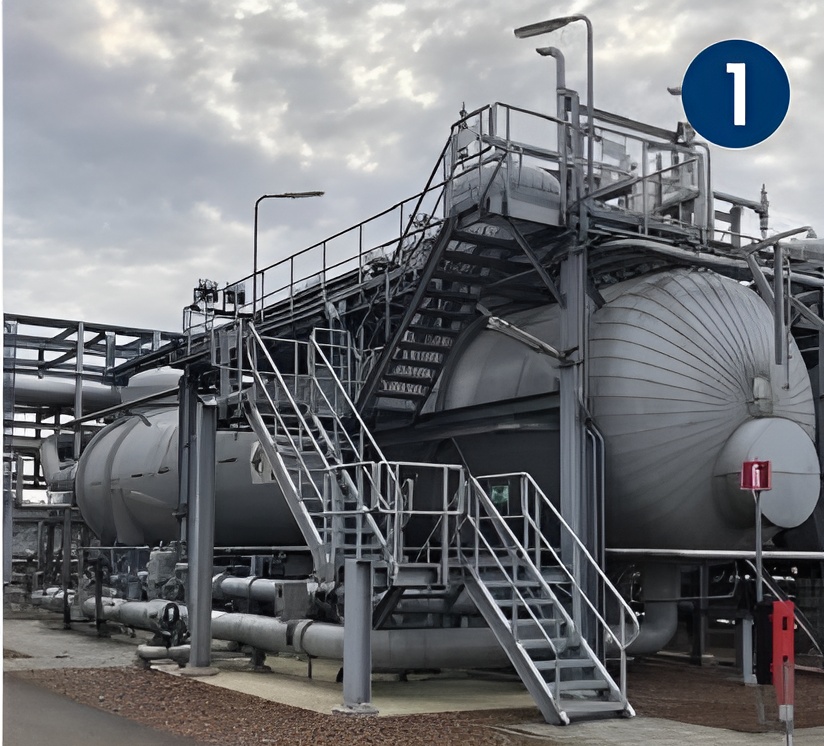
An International Oil and Gas Production Company in Europe experienced signs of inefficient separation for its multiphase separator (gas/oil/water/sludge), see Picture 1. After five years of operation the separator showed unusual dirtier water and reduced throughput due to buildup of sludge.
The oil company therefore decided to shut down the separator for a visual inspection of the separator’s interior. Therefore, the separator must be thoroughly cleaned and decommissioned.
It was assumed that the bottom of the separator contained a considerable amount of sludge, which is a mixture of sand and other settled hydrocarbons.
The oil company decided the separator should be cleaned according to “Non-Man-Entry” practices, which means that during the cleaning job it is forbidden for workers to enter the separator at any time.
SOLUTION
The operator selected a recognized industrial cleaning company, which was specialized in major tank cleaning tasks. The operator requested Rodanco to find a suitable cleaning product with major advantages.
A sample of the sludge and crude oil from an on-shore major oil field in Europe were sent to Rodanco’s state-of-the-art laboratories at Science Park in Amsterdam.
Cleaner TC5225M was the most effective product with very interesting advantages. It not only outperformed at room temperatures but also broke down the sludge quickly into three phases:
- Oil phase at the top
- Clean water phase in the middle
- Clean sand at the bottom


In the meantime, stakeholders (Rodanco, operator and cleaning company) developed a protocol to safely and effectively carry out the Non-Man-Entry cleaning job.
A SCANJET* was installed at the top of the separator. Three drains were installed at the bottom of the separator, combined with a manifold and connected to a vacuum truck with two (~70 m³) settling containers.
The SCANJET was programmed to spray pressurized liquid inside the separator, reaching almost the entire internal surface. Part of the free oil was removed by filling the separator completely with water. The cleaning job started after the water was completely drained.
RESULTS
With 3 vacuum trucks (approx. 60 m³), liquid, solids and sludge (Picture 3) were sucked out of the separator.
When no sludge came out anymore, the first batch of Cleaner TC5225M in water was prepared:
20 m³ of a 10% emulsion
This milky emulsion was jetted into the separator using the SCANJET in approximately 15 minutes, while continuously draining and removing the loosened sludge.
It is essential to keep draining the separator before sand starts to settle again. Cleaner TC5225M turned the viscous sludge into a slurry under the motion of the SCANJET, allowing it to drain easily and be removed efficiently.
Through the side glass of the suction line, it was clearly visible how the milky cleaning emulsion turned into a dark grey slurry.
This dark grey slurry was sent to one of the settling containers via the vacuum truck. In stagnant condition, Cleaner TC5225M works like a demulsifier, and the slurry separated quickly (Picture 4) into three phases comparable to laboratory tests