
Effective Strategies to Prevent Microbiologically Influenced Corrosion
Microbiologically influenced corrosion (MIC) presents a persistent threat across oil and gas, fuel storage, and industrial water treatment sectors. For producers, refiners, and industrial operators, understanding how to prevent MIC is vital to avoid costly metal corrosion, pipeline failures, and safety hazards. As detailed on Rodanco’s corrosion inhibitors page, reliable prevention relies on both chemical solutions and advanced technical approaches for long-term asset protection.
Abstract
MIC is an electrochemical process driven by microbes—primarily sulfate reducing bacteria (SRB)—producing damaging biofilm on metal surfaces exposed to water and other aggressive environments. The interface of biofilm formation and localized corrosion creates challenges in industries using stainless steel and carbon steel pipelines. Prevention necessitates targeted corrosion inhibition, optimized asset integrity management, and sustainable operational controls. This article summarizes knowledge, innovations, and best practices for mitigating MIC using modern chemical and surface engineering solutions, with emphasis on the Dutch and broader European energy sector.
State of the Knowledge on MIC
MIC is recognized for accelerating pitting corrosion and causing premature asset failure via the metabolic activity of specific microbes. Understanding MIC involves:
- Sulfate reducing bacteria (SRB) create hydrogen sulfide, a prime corrosive agent in pipelines and tanks.
- Biofilm provides a protective environment, supporting persistence and proliferation of MIC-inducing microbes.
- Corrosion rates can be unpredictable due to varied microbial populations and water chemistry.
- Stainless steel, though resistant, is not immune—especially at welds and in low-flow water sections.
- Corrosion inhibitors are often required to counteract localized attack beyond standard chemical protection.
For a deeper technical review, visit Rodanco’s field expertise page, which details real-world MIC scenarios and interventions.
Recent Progress in MIC Mitigations
Recent advances in preventing MIC include new approaches that combine chemical, mechanical, and monitoring controls:
- Innovative corrosion inhibitors specifically disrupt electron transport processes in SRB, impeding metal corrosion.
- Continuous online monitoring tracks biofilm thickness and water parameters, enabling informed chemical dosing.
- Enhanced biocides, paired with effective dispersants, help disrupt biofilm formation and inhibit microbe colonization.
- Specialty coatings create a physical barrier and can release active agents to prevent microbe adhesion.
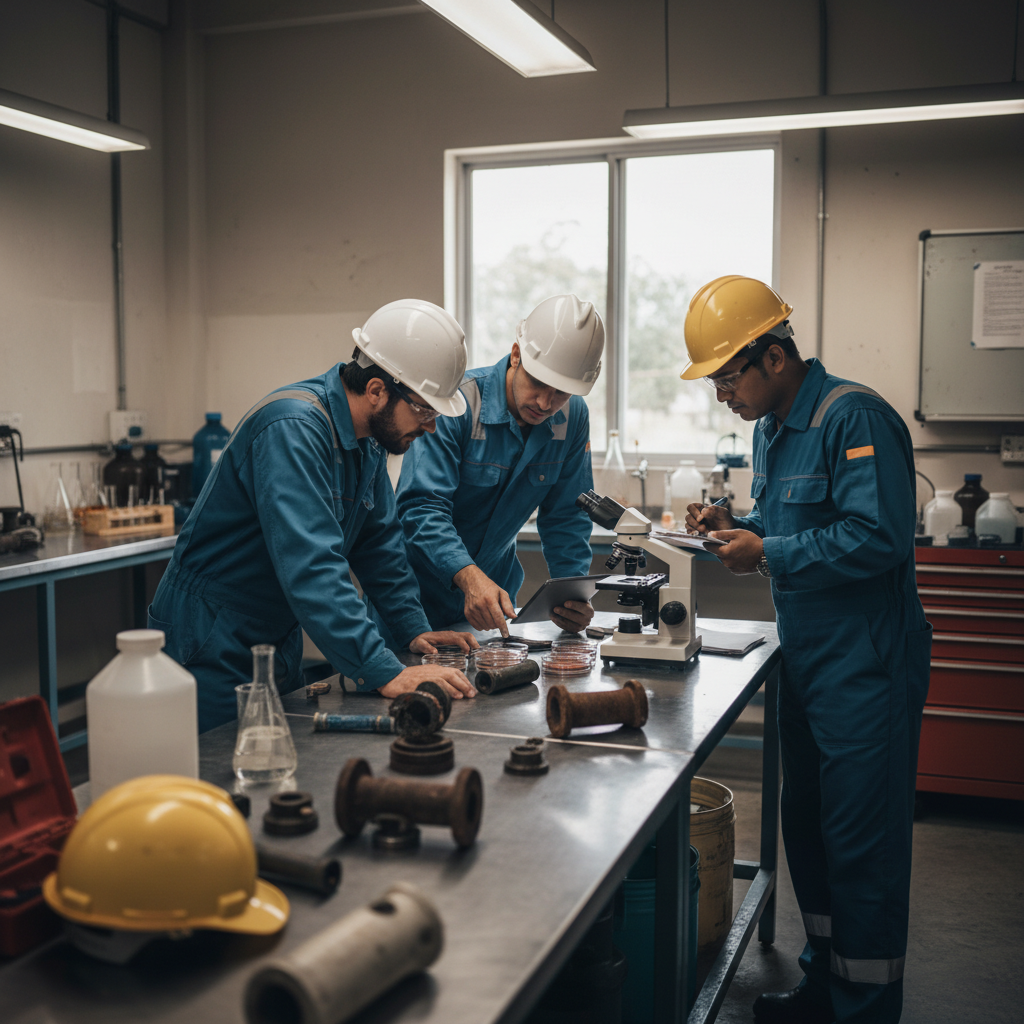
Best results are achieved by integrating lab screening, field trials, and operational insights, as discussed on Rodanco’s laboratory expertise page.
Biofilm Formation
Biofilm acts as both a catalyst and shield for microbes. Once established, biofilm accelerates metal corrosion rates and complicates mechanical cleaning.
- Biofilm consists of microbial cells and extracellular polymeric substances that attach firmly to pipeline walls.
- The film’s presence allows SRB and other microbes to dominate local chemical conditions, increasing pitting corrosion risk.
- Disruption is crucial—mechanical pigging, chemical dispersal, and targeted cleaning products all play significant roles.
- Inadequately managed biofilm can bypass even robust corrosion inhibitors.
Regular inspection and rigorous asset integrity protocols—outlined in Rodanco’s technical solutions—help operators maintain control over biofilm development within high-value infrastructure.
Quorum Sensing
Modern MIC prevention also considers quorum sensing, the mechanism microbes use to communicate and coordinate attack on metal surfaces:
- Microbes release and detect signaling molecules, adjusting their activity based on cell density.
- When a critical threshold is reached, they increase biofilm production and metal attack.
- Novel additives are being designed to disrupt these signals, breaking the cycle of biofilm maturation and severe pitting corrosion.
Blocking quorum sensing forms part of a multi-pronged approach, recommended by industry experts to supplement traditional corrosion inhibition methods.
Current Anticorrosive Coatings
Coatings remain a primary defense against direct metal corrosion and microbe colonization in the presence of water. Optimized systems for stainless steel and high-risk assets employ:
- Epoxy- and polymer-based barrier coatings to isolate the metal from corrosive agents.
- Self-healing coatings capable of releasing inhibitors at damaged sites, enhancing corrosion inhibition.
- Hybrid coatings that combine mechanical strength with antimicrobial activity to control SRB and other microbes.
For long pipelines, tanks, and sensitive water-exposed structures, consistent coating inspection, maintenance, and renewal are essential to sustained asset protection. See tank cleaning solutions for more on protective maintenance.
Application of Chitin and Chitosan in MIC Mitigations
Chitin and chitosan, biopolymers derived from natural sources, are increasingly applied as eco-friendly MIC mitigation tools. Their functions include:
- Acting as antimicrobial agents against key MIC-driving microbes including SRB.
- Inhibiting biofilm formation on pipelines and metal surfaces when incorporated into cleaning or coating products.
- Reducing reliance on conventional chemical biocides, contributing to sustainable water treatment operations.
Field studies show that chitosan solutions can be custom-formulated based on site-specific water chemistry and metal type to enhance corrosion inhibition. Operators can consult Rodanco’s water cleaning experts for tailored program design.
Chitosan Nanocomposites in MIC Mitigations
Recent research has enabled the creation of nanocomposite coatings and treatments using chitosan, further strengthening MIC control. These nanomaterials deliver unique advantages:
- Engineered for high surface area and reactivity, increasing microbial inhibition at the metal interface.
- Promote uniform dispersion of antimicrobial agents, maintaining performance across pipeline interiors.
- Added nanomaterials can provide targeted disruption of microbial cell walls within biofilm matrices.
Advanced chitosan nanocomposite coatings are considered a next-generation solution for critical infrastructure, combining reliable performance with reduced environmental risk. Review innovation updates for new product launches and case data involving nanocomposites.
Conclusion
Addressing MIC requires a holistic strategy focusing on biofilm control, corrosion inhibition, and continuous asset monitoring. By leveraging chemical, mechanical, and biotechnological advances—including chitosan-based solutions and nanomaterials—operators can significantly extend asset life, reduce unplanned downtime, and minimize operational losses. For customized solutions and technical guidance, contact specialists at Rodanco and safeguard your vital water, fuel, and pipeline infrastructure against MIC’s costly impact.