
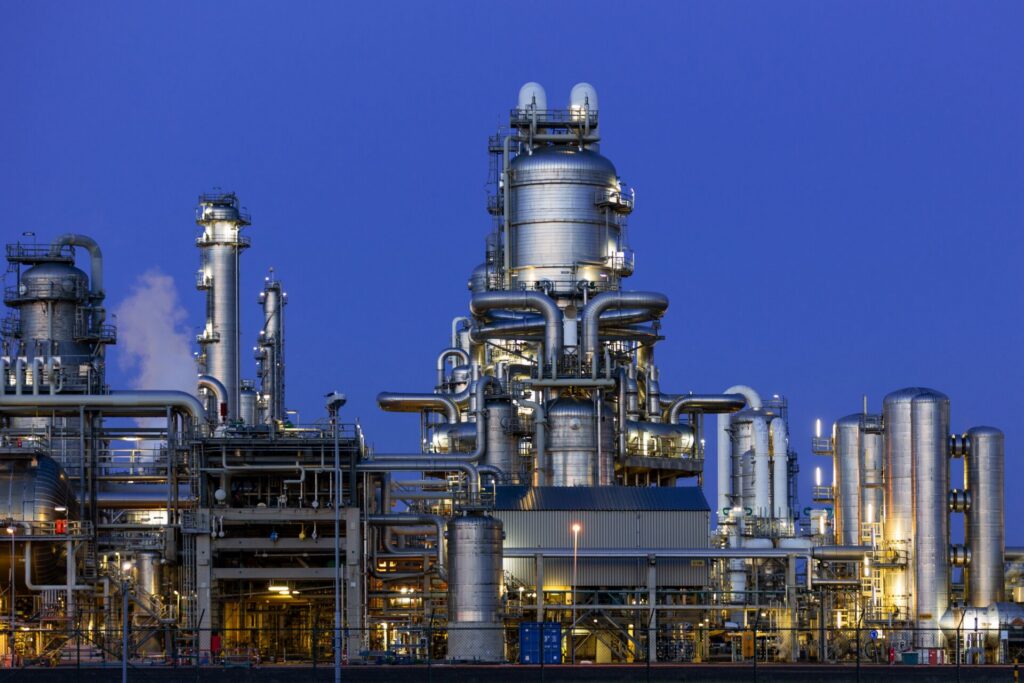
Slop oil means recovered hydrocarbon that has been contaminated with water and solids and cannot be sold or processed as a finished product without treatment. The term is used across refining, terminals, marine operations and upstream production. Despite the name, slop oil is a resource: once dewatered and de-solidified, most of it re-enters the refinery as crude unit feed or is sold as a discounted recovered hydrocarbon.
The word carries a dismissive tone that does not match the economics. A 5,000 m³ slop tank at 60% oil content holds roughly 3,000 m³ of recoverable hydrocarbon. Treated as waste, it costs money to remove. Treated as feedstock, it is inventory.
Slop oil definition by sector
The same term means slightly different things depending on where you sit in the supply chain.
| Sector | What “slop oil” refers to | Typical destination |
|---|---|---|
| Refining | Off-spec and recovered hydrocarbon from desalter, tank bottoms, separators | Reblended to crude unit charge |
| Storage terminals | Tank washings, product interfaces, line displacement | Sold as recovered oil or returned to supplier |
| Marine / bunkering | Tank washings, engine room residues, cargo residues (MARPOL Annex I) | Discharged to port reception facility |
| Upstream production | Tank bottoms, treater rag layer, pit oil | Recovered to the production stream |
| Waste processing | Collected oily waste from multiple generators | Centrifuged and sold as recovered fuel oil |
The marine definition is the strictest. Under MARPOL Annex I, slops and oily residues are regulated, must be logged in the Oil Record Book, and can only be discharged to approved reception facilities. Operators in this space have compliance obligations that refinery operators do not.
What slop oil is used for
Recovered slop oil has four realistic outlets, in descending order of value.
1. Crude unit reblending
The highest-value route. Dewatered slop is injected into the crude charge, usually at 1–2% of throughput, and processed as ordinary feed. The constraint is quality, not willingness — the desalter will not tolerate uncontrolled water, salt and solids, and chlorides carried through cause overhead corrosion.
Practical acceptance limits for reinjection are typically:
- Water (BS&W): below 2%, often below 1%
- Solids: below 0.5%
- Salt: below 10 ptb (pounds per thousand barrels), tighter at corrosion-sensitive sites
- Temperature: warm enough to remain pumpable
Meeting these means treating the slop, not simply decanting it.
2. Sale as recovered hydrocarbon
Where reinjection capacity is capped, dewatered slop is sold to blenders, recovered fuel oil producers or waste-to-energy operators. Pricing is a steep discount to crude and buyers specify water, solids, sulfur and flash point. Value rises sharply with every percentage point of water removed.
3. Fuel blending
Heavier slop with acceptable sulfur can be blended into industrial fuel oil, subject to specification and emissions constraints. Increasingly limited by sulfur regulation.
4. Disposal
The default when treatment is not attempted. Costs typically €80–250 per tonne in Western Europe, plus transport, plus the lost value of the hydrocarbon inside. This is the outcome a treatment programme exists to avoid.
How slop oil gets reprocessed
Reprocessing is about breaking a stabilised emulsion, and then keeping it broken.
Step 1 — Sample and test. A recent, representative sample is bottle-tested to establish water content, solids loading, and which demulsifier chemistry actually resolves the emulsion. Slop varies between tanks at the same site, so one sample does not characterise a system.
Step 2 — Heat and settle. Warming to 60–90 °C reduces viscosity. Settling gives free water a chance to drop before chemistry is applied.
Step 3 — Chemical treatment. A slop oil demulsifier attacks the interfacial film. Dose rates for slop are typically higher than for production emulsions — commonly 100–1,000 ppm depending on solids and age — because the emulsion is dirtier and more heavily stabilised.
Step 4 — Mechanical separation. Three-phase decanters split oil, water and solids in a single pass. Disc-stack centrifuges polish the oil phase. Chemistry and mechanics work together: better chemistry means lower throughput loss and less frequent bowl cleaning.
Step 5 — Water treatment. The separated water still carries oil. A deoiler or bioflocculant brings oil-in-water within the effluent plant’s design range.
Step 6 — Route the product. Recovered oil to crude charge or to sale; solids to licensed disposal; water to the effluent plant.
Why “slop” is a misleading word
Three assumptions the terminology encourages, all of them costly:
That it is waste. Slop oil is typically 30–70% recoverable hydrocarbon by volume. Very little industrial waste has that recovery potential.
That it is homogeneous. Slop from a desalter rag layer and slop from an off-spec gasoline batch require entirely different handling. Combining them in one tank guarantees the difficult stream sets the treatment requirement for everything.
That it can wait. Emulsion stability increases with age as films cross-link and solids consolidate at the interface. Slop treated within weeks resolves faster and at lower chemical dose than slop treated after a year. Deferring treatment makes the problem more expensive, not less.
Frequently asked questions
What does slop mean in oil and gas?
Slop refers to any off-specification or recovered liquid — usually a hydrocarbon–water mixture — that cannot go directly to a product tank. It is collected in dedicated slop tanks pending treatment or disposal.
Is slop oil the same as waste oil?
No. Waste oil generally means used lubricating oil collected for re-refining. Slop oil is process-derived off-spec hydrocarbon from refining, storage or production. Different origin, different composition, different regulatory treatment.
What is a slop tank used for?
A slop tank collects off-spec and recovered hydrocarbon streams so they can be settled, treated and reprocessed rather than sent to drain or disposal. It functions as both a buffer and a treatment vessel.
Can slop oil be refined?
Yes, after dewatering and solids removal. It is typically reinjected into the crude unit charge at low percentages rather than processed as a standalone feed.
What is the difference between slop oil and slop tank oil?
None in practice — slop tank oil simply specifies where the material is being held. Both refer to the same off-spec hydrocarbon mixture.
Where to go next
Whether slop oil is a cost or a credit at your site comes down to how much of the hydrocarbon you get back. That depends on matching chemistry to the actual emulsion rather than to a generic slop profile.
Rodanco develops slop oil demulsifiers and emulsion breakers screened against client samples in our in-house laboratory, with dosing optimised on site by our field team.
Read more about our approach to slop and waste stream treatment.
Rodanco B.V. supplies specialty chemicals to oil, gas, fuel and industrial cleaning operations across Europe from its base in Alkmaar, the Netherlands. Formulations are developed in-house and proven through on-site field trials.
Related articles
References
- Techniques for treating slop oil in the oil and gas industry: a short review. Fuel, ScienceDirect. https://www.sciencedirect.com/science/article/abs/pii/S0016236120314782
About this article
Written by the Rodanco technical team. Rodanco B.V. operates an in-house laboratory in Alkmaar, the Netherlands, running screening, compatibility testing and tailored formulation work, and a field service team conducting on-site trials and dosing optimisation across European and global energy markets.
Standards notice. Values quoted from CEN standards are given for guidance. Standards are periodically revised and national annexes differ. Always verify against the current published edition before contractual or specification use.
Last reviewed: August 2026