
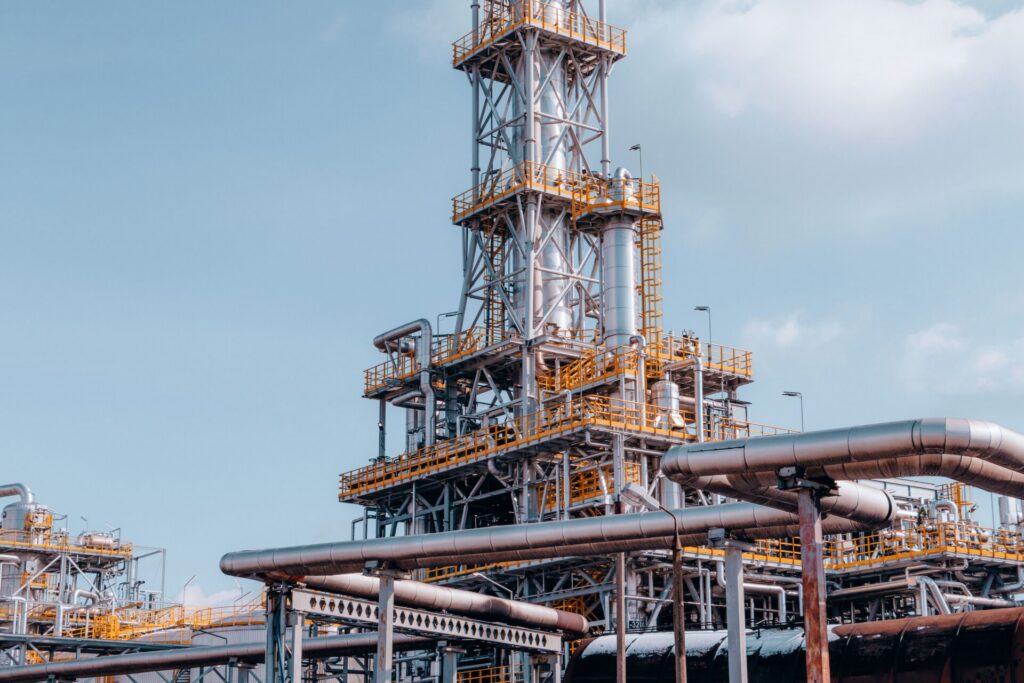
Slop oil is the off-specification hydrocarbon stream a refinery collects when oil, water and solids end up mixed together instead of separated. It is not a single product. It is whatever the plant could not route to a finished tank — desalter interface, tank bottoms, API separator skimmings, wash-down from turnarounds, and product caught between grade changeovers. Most refineries generate between 0.1% and 0.5% of crude throughput as slop, and nearly all of it is recoverable hydrocarbon that has been trapped in a stable emulsion.
That last point is what makes slop oil an economic problem rather than a housekeeping one. The oil in a slop tank is saleable material. What stands between it and the crude unit is water, solids, and the interfacial film holding the two together.
Where slop oil comes from
Slop oil is a collection point, not a process. Understanding what feeds it tells you why one refinery’s slop breaks in two hours and another’s sits for six weeks.
| Source | Typical contribution | What it brings into the tank |
|---|---|---|
| Desalter interface / rag layer | High, continuous | Fine solids, asphaltenes, naphthenates, brine |
| Storage tank bottoms | Periodic, large volume | Rust, scale, sand, aged and oxidised hydrocarbon |
| API separator and CPI skimmings | Continuous | Weathered oil, biological solids, surfactants from upstream chemistry |
| Tank cleaning and turnarounds | Campaign-based, very large | Heavy sludge, sediment, cleaning chemicals |
| Product changeovers and off-spec batches | Intermittent | Clean but off-grade hydrocarbon; usually easy to recover |
| Process unit drains, pump seals, sampling | Continuous, low volume | Mixed light and heavy ends |
| Ballast and tanker washings (coastal sites) | Campaign-based | Seawater, high salt content |
The trouble with a slop system is that these streams are usually combined. A tank receiving both light off-spec naphtha and desalter rag layer contains an emulsion nobody designed and nobody characterised.
What slop oil is actually made of
A representative refinery slop is three phases plus an interface:
- Free oil (30–70%) — recoverable hydrocarbon, often a wide boiling range because the sources are mixed
- Water (20–60%) — process water, brine from the desalter, rainwater ingress, steam condensate
- Solids (1–10%) — iron oxide, catalyst fines, sand, coke fines, scale, biomass
- The rag layer — the stabilised emulsion band sitting between oil and water, where most of the difficulty lives
Density typically runs 900–990 kg/m³ and viscosity varies enormously with temperature and asphaltene content. Salt content can be significant where desalter brine or ballast water is involved, which matters because chlorides returning to the crude unit cause corrosion in the overhead system.
Why the emulsion is so stable
Slop oil emulsions are stabilised by two mechanisms working together, which is why single-mechanism treatment often fails.
Solids stabilisation (Pickering emulsion). Fine hydrophilic and hydrophobic particles — iron sulfide, clay, catalyst fines — collect at the oil–water interface and form a mechanical barrier. Water droplets physically cannot reach each other to coalesce. Adding more heat does not remove a particle armour.
Chemical stabilisation. Asphaltenes, resins, naphthenic acids and residual production chemicals from upstream form a viscoelastic film at the interface. Carried-over demulsifiers, corrosion inhibitors, biocides and drag reducers from the crude supply chain all contribute, and none of them were designed to work together in a slop tank.
Age compounds both. Slop that has sat in an open tank for months has oxidised, the film has cross-linked, and the solids have had time to migrate to the interface and consolidate. Fresh slop is markedly easier to break than aged slop — a strong argument for treating continuously rather than accumulating.
Slop oil emulsion solids (SOES)
Refinery practice has a specific term for the fraction that will not break under normal conditions. When slop is heated and settled in a treatment tank, a portion separates as a persistent middle layer between the recovered oil and the returned water. This is slop oil emulsion solids, and it is a recognised waste stream in its own right — historically routed to the coker drum during the coking cycle rather than reprocessed.1
The practical significance is that “unbreakable” is conditional, not absolute. A middle layer that resists settling and heat alone will frequently resolve under the right demulsifier chemistry at the right dose. The volume classified as SOES at a given site is partly a measure of how hard the treatment programme is working.
Why slop oil accumulates instead of clearing
Four failure modes account for most chronically full slop tanks:
- Everything goes in the same tank. Combining an easy stream (off-spec naphtha) with a hard one (desalter rag) means the whole inventory now needs the hard treatment.
- Residence time is the only treatment. Gravity settling alone will not resolve a solids-stabilised emulsion. The rag layer thickens and the tank slowly loses working volume.
- The chemistry was selected once. Slop composition drifts with crude slate, seasonal water ingress and turnaround schedules. A demulsifier chosen against a two-year-old sample is being asked to solve a different problem.
- Reprocessing is capped. Most refineries limit slop reinjection to the crude unit to around 1–2% of charge, because water, salt and solids upset the desalter. Generation outpaces the allowable return rate and inventory climbs.
The result is a tank that operations treats as a buffer and finance treats as a liability — often with disposal costs of €80–250 per tonne for material that contains recoverable product.
How refineries treat slop oil
Effective treatment is a sequence, not a single step. Each stage removes what the next stage cannot handle.
- Characterise the stream. Bottle test on a representative, recent sample: BS&W, solids content and particle size, density, viscosity, salt content, and pH. Treat this as mandatory, not optional — the results determine everything downstream.
- Heat. Raising temperature to 60–90 °C lowers viscosity and increases droplet mobility. Necessary but rarely sufficient.
- Chemical demulsification. A slop oil demulsifier destabilises the interfacial film and displaces stabilising species so droplets can coalesce. Slop-specific chemistry differs from production demulsifiers because it must handle high solids and a wide, unpredictable boiling range.
- Solids removal. Where solids exceed roughly 2–3%, mechanical separation — three-phase decanter or disc-stack centrifuge — becomes necessary. Chemical treatment reduces the load on this equipment but does not replace it.
- Water polishing. The separated aqueous phase carries residual oil. A deoiler or water clarifier brings oil-in-water down to a level the effluent plant can accept.
- Route the recovered oil. Blend back to crude within desalter tolerance, or sell as a recovered hydrocarbon stream.
A well-designed programme routinely recovers 70–90% of the hydrocarbon in a slop tank. That converts a disposal cost into a credit, and frees tank capacity that was doing no work.
Frequently asked questions
Is slop oil hazardous waste?
Classification depends on composition and jurisdiction. Under the European Waste Catalogue, oily sludges and slops typically fall under Chapter 05 or 13 codes and are often classified hazardous due to hydrocarbon content. Confirm classification with your local competent authority before shipping.
What is the difference between slop oil and oily sludge?
Slop oil is predominantly liquid — a pumpable oil–water–solids mixture. Oily sludge is the heavier, solids-rich material that settles out, often semi-solid and requiring mechanical handling. In practice they exist on a continuum, and a slop tank usually contains both.
Can slop oil be sold?
Yes. Recovered and dewatered slop oil is traded as a low-grade feedstock, though pricing is heavily discounted against crude and buyers will specify maximum water, solids and salt content. Recovery to a saleable spec almost always beats disposal economically.
How much slop oil does a refinery produce?
Typically 0.1–0.5% of crude throughput under normal operation, rising sharply during turnarounds and tank cleaning campaigns.
Why does slop oil separate more slowly in winter?
Lower ambient temperature increases viscosity and slows droplet settling, and rainwater ingress adds volume. Heating and increased demulsifier dose are both usually required seasonally.
Where to go next
If your slop inventory is growing faster than you can reprocess it, the first question is not which chemical to buy — it is what is actually in the tank. Rodanco’s laboratory runs bottle tests and compatibility screening on client slop samples, and our field team validates the selected chemistry on site under real dosing conditions.
Explore our approach to slop and waste stream treatment, or read about slop oil demulsifiers and emulsion breakers.
Rodanco B.V. is a specialty chemicals supplier based in Alkmaar, the Netherlands, serving upstream, midstream, downstream and renewable fuel operators across Europe. Our formulations are developed and screened in-house and validated through on-site field trials.
Related articles
References
- Recycle of oily refinery wastes — description of slop oil treatment tank operation and the slop oil emulsion solids middle layer routed to the coker. US Patent and Trademark Office. https://image-ppubs.uspto.gov/dirsearch-public/print/downloadPdf/5009767
- Techniques for treating slop oil in the oil and gas industry: a short review. Fuel, ScienceDirect. https://www.sciencedirect.com/science/article/abs/pii/S0016236120314782
About this article
Written by the Rodanco technical team. Rodanco B.V. operates an in-house laboratory in Alkmaar, the Netherlands, running screening, compatibility testing and tailored formulation work, and a field service team conducting on-site trials and dosing optimisation across European and global energy markets.
Standards notice. Values quoted from CEN standards are given for guidance. Standards are periodically revised and national annexes differ. Always verify against the current published edition before contractual or specification use.
Last reviewed: August 2026